Custodia vs Traditional Receipt-Based Spend Management

Introduction
If your company still relies on paper or emailed receipts to manage spending, you know how quickly the process can become slow, manual, and difficult to control. Custodia offers a modern alternative to traditional receipt-based spend management, helping teams track expenses in real time, reduce administrative work, and improve compliance across the organization.
This article compares Custodia with traditional spend management methods and highlights the advantages of moving to a more efficient, automated approach.
What is traditional receipt-based spend management?
Traditional spend management often depends on employees paying out of pocket, collecting receipts, submitting expense reports, and waiting for approval before reimbursement. Finance teams then review each receipt manually, match it to policy, and process payment.
While this method is familiar, it can create delays, missing documentation, inconsistent policy enforcement, and a heavy administrative workload for both employees and finance teams.
How Custodia changes spend management
Custodia is designed to simplify spend management by giving businesses better visibility, automation, and control. Instead of relying on receipts as the primary source of truth, Custodia helps teams capture spending data as it happens and manage expenses through a more streamlined workflow.
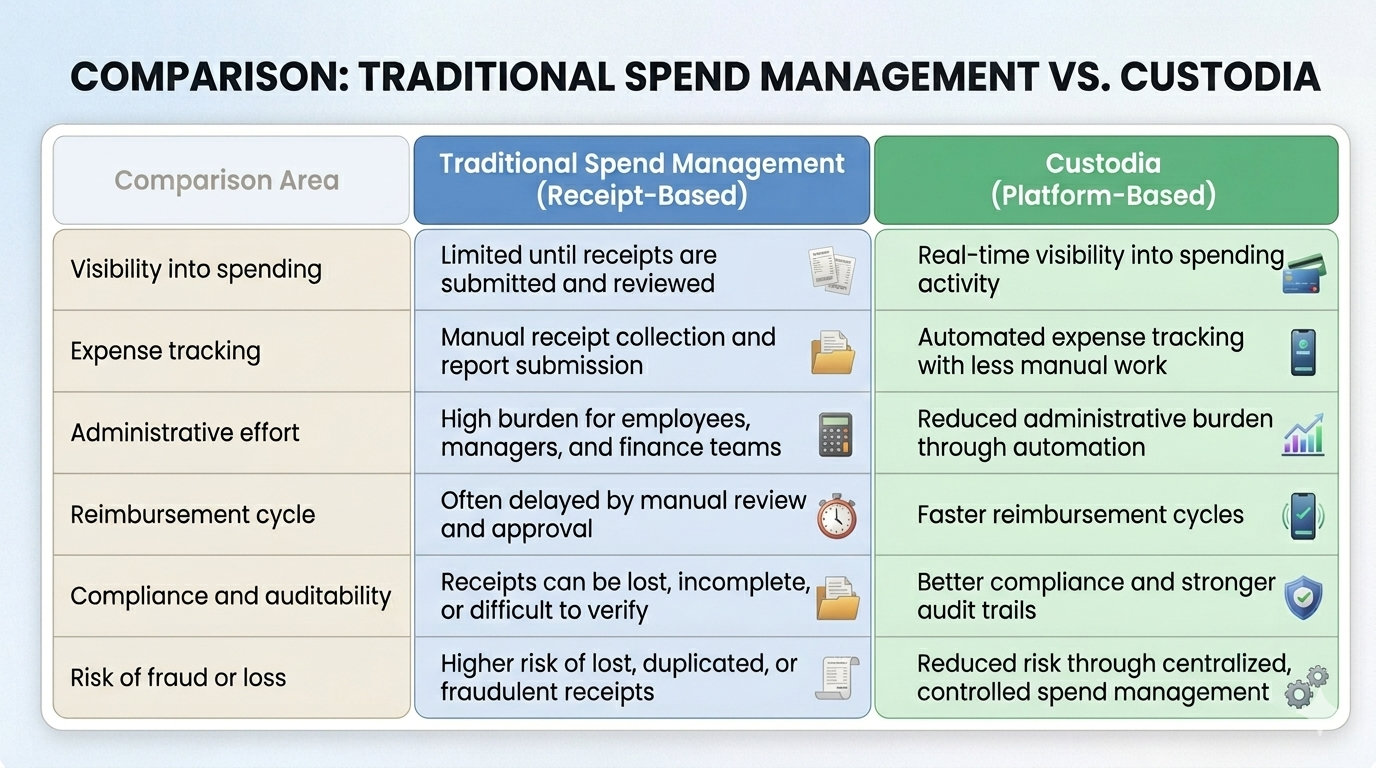
Custodia vs traditional spend management
Key advantages of Custodia
Real-time visibility into spending
With Custodia, finance leaders and managers can see spending activity as it happens. This makes it easier to monitor budgets, identify unusual transactions, and make faster decisions based on current data rather than waiting for receipt submissions.
Automated expense tracking
Traditional receipt-based workflows depend on employees saving receipts, filling out forms, and manually entering details. Custodia reduces that effort by automating expense tracking, which helps teams save time and lowers the chance of errors.
Reduced administrative burden
When receipts are the foundation of the process, employees, managers, and finance teams all spend time chasing documentation and resolving exceptions. Custodia streamlines these tasks, freeing teams to focus on higher-value work.
Faster reimbursement cycles
Because expense data is captured and organized more efficiently, approvals and reimbursements can move faster. This improves the employee experience and helps companies avoid delays caused by missing or late receipts.
Better compliance and audit trails
Custodia helps create a clearer record of spending activity, making it easier to enforce policy and support audits. Compared with scattered receipt files, centralized spend data provides a more reliable audit trail.
Lower risk of lost or fraudulent receipts
Paper receipts can be misplaced, damaged, or altered. Digital spend management through Custodia helps reduce these risks by minimizing dependence on physical documentation and improving control over expense records.
Cost and time savings
By reducing manual work, shortening reimbursement cycles, and improving visibility, Custodia can help companies save both time and money. These efficiencies can add up quickly across teams with frequent spending activity.
Why companies choose Custodia
Companies that rely on receipts often reach a point where the old process no longer scales. Custodia is a modern spend management solution for organizations that want better control, less paperwork, and a more efficient way to manage expenses.
For business decision makers, the value is clear: more visibility, stronger compliance, faster workflows, and a better experience for employees and finance teams alike.
Conclusion
Traditional receipt-based spend management can be slow, manual, and difficult to control. Custodia offers a more modern approach with real-time visibility, automated tracking, reduced administrative effort, faster reimbursements, and stronger compliance.
If your company is looking for a more efficient way to manage spending, Custodia provides a clear alternative to outdated receipt-based processes.
Please sign in to leave a comment.
Comments
0 comments